
Sermon's Title: Gambling: Filth and Hatred
Themes of the Sermon:
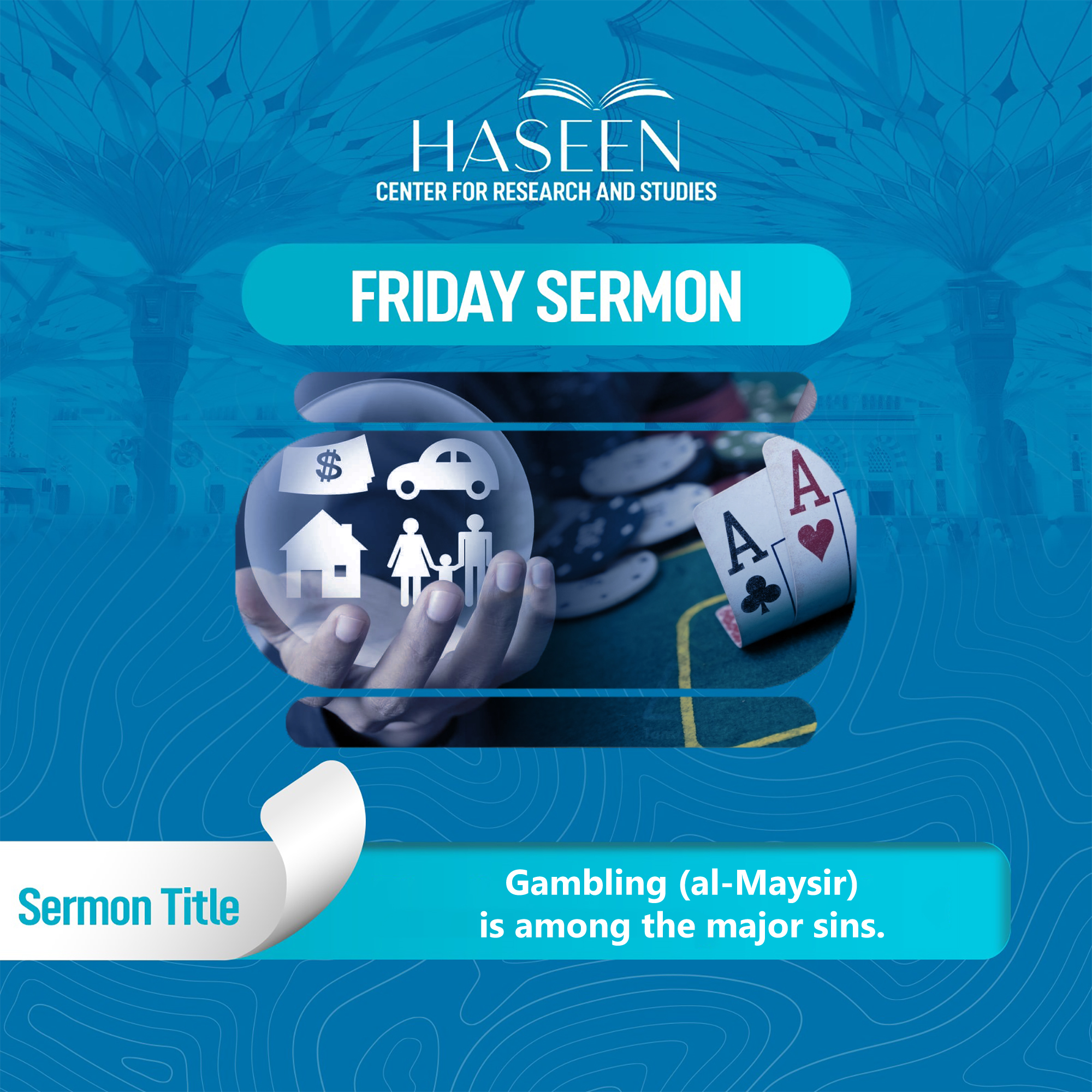
1- Gambling (al-Maysir) is among the major sins.
2- Some prohibited forms of gambling.
3- The harmful effects of gambling on society.
All praise is due to Allah, who has permitted what is wholesome through His generosity and mercy, and who has forbidden what is vile through His justice and wisdom. I bear witness that there is no deity worthy of worship except Allah alone, with no partner, and I bear witness that Muḥammad is His servant and His Messenger. May Allah send abundant peace and blessings upon him.
To proceed: Fear Allah, O servants of Allah, with true fear of Him, and be mindful of Him in private and in secret. Allah the Exalted says:
يَا أَيُّهَا الَّذِينَ آمَنُوا اتَّقُوا اللَّهَ حَقَّ تُقَاتِهِ وَلَا تَمُوتُنَّ إِلَّا وَأَنْتُمْ مُسْلِمُونَ
“O you who believe, fear Allah as He should be feared, and do not die except in a state of Islam.” [Sūrat Āl ʿImrān: 102]
O servants of Allah:
Have you heard of the horse of Satan?
The Prophet ﷺ said: “Horses are of three kinds: a horse for the Most Merciful, a horse for a human being, and a horse for Satan. As for the horse of the Most Merciful, it is the one that is kept in the path of Allah; its fodder, its droppings, and its urine”—and he mentioned whatever Allah willed—“all of that carries reward. As for the horse of Satan, it is the one upon which gambling or betting is done. And as for the horse of the human being, it is the horse that a person keeps seeking what is in its womb”—meaning its offspring—“and it shields him from poverty.” Narrated by Aḥmad.
The horse of Satan, then, is the one upon which betting and gambling take place.
Satan, the accursed, never ceases to tempt people away from the religion of Allah, and among his greatest entrances is unlawful wealth.
The Prophet ﷺ spoke the truth when he said: “Every nation has a trial, and the trial of my nation is wealth.” Narrated by Aḥmad.
In an age where people rush toward becoming rich by any means, the condition of many has become as the Prophet ﷺ described: “There will come a time upon people when a person will not care whether what he acquires is from what is lawful or from what is unlawful.” Narrated by al-Bukhārī.
Among the vilest ways of acquiring wealth, in the past and in the present, are gambling and games of chance (al-maysir and al-qimār). In the pre-Islamic period, people would purchase a camel to slaughter it, then cast their arrows. Whoever’s arrow came out would take his share of the meat without paying anything, while the one whose arrow came out last would bear the entire cost and receive none of the meat.
People came to ask the Messenger of Allah ﷺ about this, and Allah revealed the verse:
يَسْأَلُونَكَ عَنِ الْخَمْرِ وَالْمَيْسِرِ قُلْ فِيهِمَا إِثْمٌ كَبِيرٌ وَمَنَافِعُ لِلنَّاسِ وَإِثْمُهُمَا أَكْبَرُ مِنْ نَفْعِهِمَا
“They ask you about wine and gambling. Say: In them is great sin, and some benefit for people, but their sin is greater than their benefit.” [Sūrat al-Baqarah: 219]
Then Islam prohibited it decisively, when Allah the Exalted said:
يَا أَيُّهَا الَّذِينَ آمَنُوا إِنَّمَا الْخَمْرُ وَالْمَيْسِرُ وَالْأَنْصَابُ وَالْأَزْلَامُ رِجْسٌ مِنْ عَمَلِ الشَّيْطَانِ فَاجْتَنِبُوهُ لَعَلَّكُمْ تُفْلِحُونَ
“O you who believe, indeed wine, gambling, stone altars, and divining arrows are filth from the work of Satan, so avoid them that you may be successful.” [Sūrat al-Māʾidah: 90]
Allah described it as filthy and impure, and as part of Satan’s work, and He commanded that it be avoided. Then He clarified the wisdom behind its prohibition, saying:
إِنَّمَا يُرِيدُ الشَّيْطَانُ أَنْ يُوقِعَ بَيْنَكُمُ الْعَدَاوَةَ وَالْبَغْضَاءَ فِي الْخَمْرِ وَالْمَيْسِرِ وَيَصُدَّكُمْ عَنْ ذِكْرِ اللَّهِ وَعَنِ الصَّلَاةِ فَهَلْ أَنْتُمْ مُنْتَهُونَ
“Satan only wants to cause between you hostility and hatred through wine and gambling, and to avert you from the remembrance of Allah and from prayer. So will you not desist?” [Sūrat al-Māʾidah: 91]
The Prophet ﷺ also forbade it, as reported in the narration of ʿAbd Allāh ibn ʿAmr ibn al-ʿĀṣ, may Allah be pleased with them both, that the Prophet ﷺ: “Prohibited wine, gambling, the drum (al-kūbah), and al-ghubayrāʾ.” Narrated by Abū Dāwūd.
Al-kūbah refers to the drum and similar musical instruments, and al-ghubayrāʾ is an intoxicating drink made from corn.
You may ask: how does gambling create hostility and hatred among Muslims?
Gambling is a way of acquiring money easily, without effort or hardship, but through a crooked method based on chance and uncertainty. It has many forms.
Among them is gambling within transactions, where a person enters into a contract—such as a sale or a lease—paying money or labor in exchange for something that he may or may not receive. What drives him to this is risk-taking and speculation, hoping to gain something greater and more valuable than what he paid. Satan tempts him with the possibility of acquiring abundant wealth without effort, or convinces him that the loss is minor when compared to the chance of winning and profit.
These forms are many, but they all share uncertainty and ignorance regarding whether the thing for which money or compensation is paid will actually be obtained. Scholars have stipulated that for a sale to be valid, the item must be known and deliverable. Selling what cannot be delivered falls under gambling.
The Prophet ﷺ forbade this, as reported by Abū Hurayrah, may Allah be pleased with him, who said: “The Messenger of Allah ﷺ forbade the sale determined by throwing stones, and the sale involving uncertainty.” Narrated by Muslim.
Among its most widespread contemporary forms—those that have become common afflictions—are commercial insurance contracts, such as insurance on life, cars, factories, goods, and the like. These are forms of prohibited gambling, because each participant pays a known amount of money, yet may receive compensation far greater than what he paid in the event of death or an accident, or may receive nothing at all. If harm occurs, he takes more than what he paid; if nothing happens, he loses what he paid.
What is required of the believer is to place trust in his Lord for the protection of his life and wealth, and to follow lawful means in doing so. He should maintain the prescribed remembrances for protection, take permissible precautions, and not allow fear of the future to lead him into what Allah has forbidden.
Another form that has filled marketplaces is what is known as prize coupons and promotional draws. In these cases, a product is sold for more than its known price, while announcing that a prize will be given to some buyers through a draw or similar means. People then purchase the product not out of desire for it, but in order to enter the draw, hoping to win. If they win, they rejoice in easy gain without effort; if they do not, they grieve and feel regret.
All transactions involving gambling and games of chance give rise to hostility and hatred. While the winner rejoices in easy gain without hardship, the hearts of the losers fill with resentment and anger over the loss of their wealth. What kind of society can be expected to stand upon transactions based on gambling and games of chance?
Gambling is a form of prohibited maysir by scholarly consensus. ʿAbd Allāh ibn ʿUmar, may Allah be pleased with him, said: “Maysir is gambling.” Narrated by Ibn Abī Ḥātim.
Most often, gambling appears in competitions and betting.
Its form in competitions is that each contestant or team pays a sum of money, and the winning team takes the money to the exclusion of all others. This is a form of maysir (gambling) that the Prophet ﷺ prohibited when he said:
“There is no prize money except in archery, camel racing, or horse racing.” Narrated by Abū Dāwūd.
Here, the Prophet ﷺ prohibited both taking and giving prize money—meaning monetary rewards in competitions—except in horse racing, camel racing, and archery. Scholars have also included under this category anything that benefits jihād and similar lawful purposes, such as competitions in memorizing the Qurʾān and beneficial academic contests. This is because not everything that is permissible to do is also permissible to receive money for in every manner.
Among gambling and maysir are wagers, such as when one person says: “I bet you such-and-such an amount of money that this will happen or that it will not happen.” All of this falls under consuming people’s wealth unlawfully. Allah the Exalted says:
يَا أَيُّهَا الَّذِينَ آمَنُوا لَا تَأْكُلُوا أَمْوَالَكُمْ بَيْنَكُمْ بِالْبَاطِلِ إِلَّا أَنْ تَكُونَ تِجَارَةً عَنْ تَرَاضٍ مِنْكُمْ
“O you who believe, do not consume your wealth among yourselves unjustly, except through trade conducted by mutual consent.” [Sūrat al-Nisāʾ: 29]
O servants of Allah:
Islam has been severe in prohibiting gambling and has classified it among the major sins, to the extent that it blocked every path leading to it. The Prophet ﷺ even prohibited playing dice, even when there is no material gain involved. He ﷺ said:
“Beware of these two marked cubes that are thrown, for they are the gambling of non-Arabs.” Narrated by Aḥmad.
And he ﷺ said: “Whoever plays nardashīr (a dice-based game), it is as though he has dipped his hand into the flesh and blood of a pig.” Narrated by Muslim.
In fact, the Prophet ﷺ commanded a person who merely intended to gamble—but did not carry it out—to atone for that corrupt intention. He ﷺ said:
“Whoever says to his companion, ‘Come, let me gamble with you,’ let him give charity.” Narrated by al-Bukhārī and Muslim.
May Allah bless me and you through the Mighty Qurʾān, and benefit me and you through its verses and wise reminder. I seek forgiveness from Allah for myself and for you, so seek His forgiveness; indeed, He is the Most Forgiving, the Most Merciful.
The Second Sermon:
All praise is due to Allah, and may peace and blessings be upon the Messenger of Allah, upon his family, his Companions, and those who follow him. To proceed:
Indeed, the Sharīʿah is founded upon achieving benefits and perfecting them, and preventing harms and reducing them. Allah has legislated trade and placed conditions upon it through which people’s interests are preserved, allowing them to exchange goods and benefits through just means, without oppression or injustice. Everything that the Sharīʿah has prohibited is prohibited because its harm is either pure or outweighs any benefit.
Whoever reflects upon gambling and games of chance will find in them an invitation to abandon work, to resort to trickery in acquiring wealth without compensation, to rely on coincidence and blind luck, to engage in uncertainty and deception, and to consume people’s wealth unlawfully.
How many homes have been destroyed, how much wealth has been lost, and how many men have lost their wealth—and perhaps even their honor—at gambling tables. And we will be held accountable for this on the Day of Resurrection.
The Prophet ﷺ said: “The feet of a servant will not move on the Day of Resurrection until he is asked about his life and how he spent it, about his knowledge and what he did with it, about his wealth—where he earned it from and how he spent it—and about his body and how he wore it out.” Narrated by al-Tirmidhī.
O servants of Allah:
Islam requires complete submission and compliance to Allah the Exalted in all His commands. Matters of wealth, trade, buying, and selling do not lie outside the scope of the Sharīʿah such that a person may do whatever he wishes. This is why the Prophet of Allah, Shuʿayb, peace be upon him, forbade his people from cheating in measure and weight. They responded mockingly, saying:
يَا شُعَيْبُ أَصَلَاتُكَ تَأْمُرُكَ أَنْ نَتْرُكَ مَا يَعْبُدُ آبَاؤُنَا أَوْ أَنْ نَفْعَلَ فِي أَمْوَالِنَا مَا نَشَاءُ إِنَّكَ لَأَنْتَ الْحَلِيمُ الرَّشِيدُ
“O Shuʿayb, does your prayer command you that we abandon what our forefathers worship, or that we not do as we please with our wealth? Indeed, you are the forbearing, the wise.” [Sūrat Hūd: 87]
O servants of Allah:
We are entrusted with this wealth, which belongs to Allah. We are nothing but servants of the Wise King, glorified be He. We obey His commands and refrain from His prohibitions. We do not possess absolute freedom to engage in every form of transaction prevalent today under capitalist and liberal ideologies. Rather, we will be questioned tomorrow before Allah about our wealth—its sources and its uses.
O Allah, grant victory to Islam and honor the Muslims, and destroy the Zionist criminals. O Allah, send down tranquility into the hearts of those striving in Your path, rescue Your oppressed servants, and raise high the banner of the religion—by Your power, O All-Powerful, O Ever-Strong.
O Allah, forgive the Muslim men and Muslim women, the believing men and believing women, the living among them and the dead. O Allah, grant success to our leader in authority in that which You love and are pleased with, and guide him firmly to righteousness and God-consciousness. Our Lord, grant us good in this world and good in the Hereafter, and protect us from the punishment of the Fire.
O servants of Allah, remember Allah with much remembrance, and glorify Him morning and evening. And our final supplication is that all praise belongs to Allah, Lord of all worlds.