
Sermon's Title: Contemporary Filial Disobedience
Themes of the Sermon:
1- Exalting the Rights of Parents
2- The Obligation of Dutifulness and the Prohibition of Disobedience
3- Mockery and Undermining the Status of Parents
4- Obedience to Parents is Not Absolute.
All praise belongs to Allah, who commands justice and good conduct and forbids oppression and transgression. I bear witness that there is no deity worthy of worship except Allah alone, without any partner, and I bear witness that Muḥammad is His servant and Messenger. May Allah grant him abundant peace and blessings.
To proceed: Fear Allah, O servants of Allah, with true mindfulness and piety, and remain conscious of Him in secret and in public.
يَا أَيُّهَا الَّذِينَ آمَنُوا اتَّقُوا اللَّهَ حَقَّ تُقَاتِهِ وَلَا تَمُوتُنَّ إِلَّا وَأَنْتُمْ مُسْلِمُونَ
“O you who believe, fear Allah as He should be feared and do not die except as Muslims [in submission to Him].” [Sūrat Āl ʿImrān: 102].
Servants of Allah:
One night, the Prophet ﷺ saw in his dream that he was in Paradise. He said: “I heard the voice of a reciter reciting, so I asked, 'Who is this?' They said, 'This is Ḥārithah ibn an-Nuʿmān.'” The Messenger of Allah ﷺ then said: “Such is dutifulness, such is dutifulness!” And he was the most dutiful of people to his mother. Reported by Aḥmad.
Indeed, the right of parents is among the greatest rights after the right of Allah, the Blessed and Exalted. For this reason, our Lord followed the mention of His right with the right of parents, saying:
وَاعْبُدُوا اللَّهَ وَلَا تُشْرِكُوا بِهِ شَيْئًا وَبِالْوَالِدَيْنِ إِحْسَانًا
“Worship Allah and associate nothing with Him, and to parents do good.” [Sūrat an-Nisāʾ: 36].
And He, Glory be to Him, said:
وَوَصَّيْنَا الْإِنْسَانَ بِوَالِدَيْهِ حَمَلَتْهُ أُمُّهُ وَهْنًا عَلَى وَهْنٍ وَفِصَالُهُ فِي عَامَيْنِ أَنِ اشْكُرْ لِي وَلِوَالِدَيْكَ إِلَيَّ الْمَصِيرُ
“And We have enjoined upon man [care] for his parents. His mother carried him, [increasing her] in weakness upon weakness, and his weaning is in two years. Be grateful to Me and to your parents; to Me is the final destination.” [Sūrat Luqmān: 14].
These are clear verses establishing the obligation of treating parents with excellence and being grateful to them in word and deed. This is because parents are the cause of their children's existence; they spend their lives working, giving, and sacrificing for their sake, preferring their children over themselves. They find no joy in life except when their children are happy, and therefore being dutiful to them is among the deeds most beloved to Allah.
The Prophet ﷺ was asked: "Which deed is most beloved to Allah?" He said: “Prayer at its proper time.” It was asked, "Then which?" He said: “Then dutifulness to parents.” It was asked, "Then which?" He said: “Then striving in the cause of Allah.” Reported by al-Bukhārī and Muslim.
Islam elevated the mother above the father in terms of dutifulness due to the immense hardship she endured in carrying him, giving birth to him, and taking care of him during his childhood. Allah, Glory be to Him, said:
وَوَصَّيْنَا الْإِنْسَانَ بِوَالِدَيْهِ إِحْسَانًا حَمَلَتْهُ أُمُّهُ كُرْهًا وَوَضَعَتْهُ كُرْهًا وَحَمْلُهُ وَفِصَالُهُ ثَلَاثُونَ شَهْرًا
“And We have enjoined upon man, to his parents, good treatment. His mother carried him with hardship and gave birth to him with hardship, and his gestation and weaning period is thirty months.” [Sūrat al-Aḥqāf: 15].
A man came to the Messenger of Allah ﷺ and said: "O Messenger of Allah, who among people is most deserving of my good companionship?" He said: “Your mother.” The man asked, "Then who?" He said: “Then your mother.” The man asked, "Then who?" He said: “Then your mother.” The man asked, "Then who?" He said: “Then your father.” Reported by al-Bukhārī and Muslim.
And he ﷺ said: “Indeed Allah enjoins upon you [dutifulness to] your mothers—saying it three times—indeed Allah enjoins upon you [dutifulness to] your fathers, indeed Allah enjoins upon you [dutifulness to] the closest relatives, then the next closest.” Reported by Ibn Mājah.
When a man came to the Prophet ﷺ asking his permission to participate in military struggle (Jihād), he asked him: “Is your mother alive?” The man replied, "Yes, O Messenger of Allah." He said: “Woe to you! Stay by her feet, for Paradise is there!” Reported by Ibn Mājah.
Consider this man from Yemen whom Ibn ʿAbbās (may Allah be pleased with them both) saw circumambulating the Kaʿbah while carrying his mother on his back, saying:
I am her submissive camel,
If her riding mounts get startled, I do not get startled!
Then he asked: "O Ibn ʿUmar! Do you think I have repaid her?" He replied: "No, not even for a single groan of childbirth." Reported by al-Bukhārī in al-Adab al-Mufrad.
Then Allah, Glory be to Him, followed the rights of mothers with the rights of fathers, because of the great effort he makes for his children in providing for them, raising them, and bearing hardships along the way. That is why the Prophet ﷺ said: “The pleasure of the Lord is in the pleasure of the father, and the anger of the Lord is in the anger of the father.” Reported by at-Tirmidhī.
And the Messenger of Allah ﷺ said: “No child can repay his father unless he finds him enslaved, buys him, and sets him free.” Reported by Muslim.
Allah has forbidden filial disobedience (ʿuqūq), to the extent that He, Glory be to Him, forbade the slightest expression of annoyance or discontent. Allah the Almighty said:
وَقَضَى رَبُّكَ أَلَّا تَعْبُدُوا إِلَّا إِيَّاهُ وَبِالْوَالِدَيْنِ إِحْسَانًا إِمَّا يَبْلُغَنَّ عِنْدَكَ الْكِبَرَ أَحَدُهُمَا أَوْ كِلَاهُمَا فَلَا تَقُلْ لَهُمَا أُفٍّ وَلَا تَنْهَرْهُمَا وَقُلْ لَهُمَا قَوْلًا كَرِيمًا * وَاخْفِضْ لَهُمَا جَنَاحَ الذُّلِّ مِنَ الرَّحْمَةِ وَقُلْ رَبِّ ارْحَمْهُمَا كَمَا رَبَّيَانِي صَغِيرًا
“And your Lord has decreed that you not worship except Him, and to parents, good treatment. Whether one or both of them reach old age [while] with you, say not to them [so much as], 'uff,' and do not repel them but speak to them a noble word. And lower to them the wing of humility out of mercy and say, 'My Lord, have mercy upon them as they brought me up [when I was] small.'” [Sūrat al-Isrāʾ: 23-24].
A noble word means every polite, gentle, soft, and good word. A man once asked Saʿīd ibn al-Musayyib (may Allah have mercy on him), saying: "I have understood everything Allah mentioned in the Qur'an regarding dutifulness to parents, except His saying:
وَقُلْ لَهُمَا قَوْلًا كَرِيمًا
“and speak to them a noble word” [Sūrat al-Isrāʾ: 23].
What is this noble word?" Ibn al-Musayyib replied: "It is the speech of a sinful servant to a harsh master." Reported by Ibn Wahb. He meant that a child should address his parents just as an erring servant speaks to his strict master.
When a man came to the Prophet ﷺ saying: "I have come to pledge allegiance to you for emigration (Hijrah), and I left my parents weeping," the Prophet ﷺ said: “Return to them and make them laugh just as you made them weep.” Reported by an-Nasāʾī.
Servants of Allah:
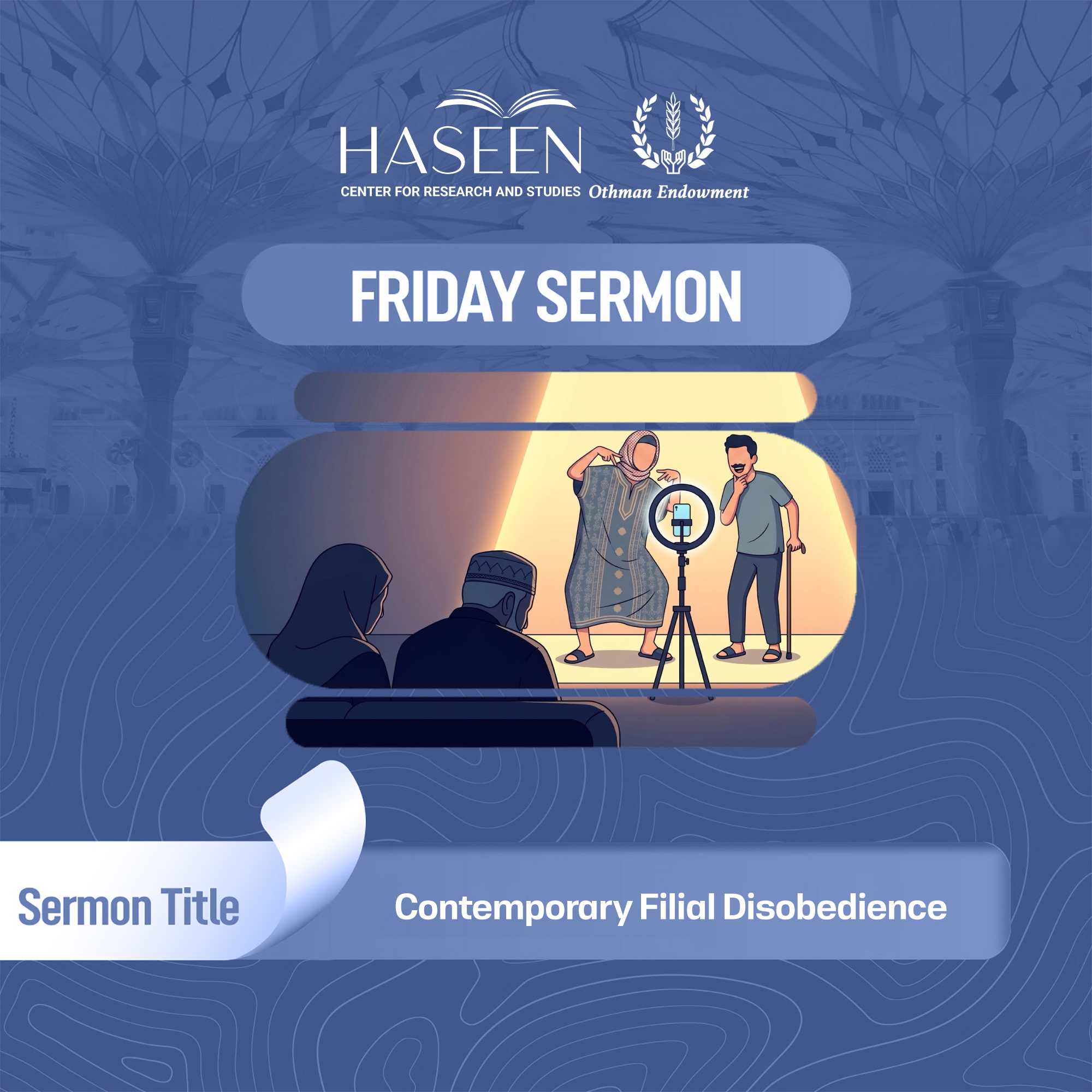
Indeed, among the widespread afflictions of recent years is what modern social media platforms have caused in spreading evils—namely through broadcasting videos containing that which does not please Allah the Almighty. Among these are clips that encourage children to be disrespectful and disobedient (ʿuqūq) to their parents by mocking them, their care, their advice, and their sacrifices, while presenting all of this in a comical and humorous light. As a result, many children of Muslims have become emboldened against their parents and holding their actions in contempt.
Filial disobedience is one of the major sins (kabāʾir); in fact, the Prophet ﷺ ranked disobedience to parents as being among the greatest of major sins. Reported by al-Bukhārī and Muslim.
The Prophet ﷺ also said: “There are three whom Allah, the Mighty and Majestic, will not look at on the Day of Resurrection: the one who is disobedient to his parents, the woman who imitates men, and the dayyūth (the man who lacks protective jealousy over his family).” Reported by an-Nasāʾī.
If harming parents even with the word "uff" (an expression of annoyance) is a forbidden form of disobedience, then how about mocking them, laughing at them, and imitating their actions by way of belittlement and contempt?! Did Allah the Almighty not say:
يَا أَيُّهَا الَّذِينَ آمَنُوا لَا يَسْخَرْ قَوْمٌ مِنْ قَوْمٍ عَسَى أَنْ يَكُونُوا خَيْرًا مِنْهُمْ وَلَا نِسَاءٌ مِنْ نِسَاءٍ عَسَى أَنْ يَكُنَّ خَيْرًا مِنْهُنَّ
“O you who believe, let not a people ridicule [another] people; perhaps they may be better than them; nor let women ridicule [other] women; perhaps they may be better than them.” [Sūrat al-Ḥujurāt: 11].
And the Prophet ﷺ said: “I would not like to imitate anyone, even if I were to get such and such for it.” Reported by Abū Dāwūd.
Imitating parents in a belittling manner is both filial disobedience and backbiting (ghībah), and both are major sins. Scholars have considered that anything through which you convey to another person the flaw or defect of a Muslim is prohibited backbiting. Among such acts is imitation—such as walking with a limp, bowing your head, or assuming other physical postures with the intention of mimicking the appearance of the person you are belittling.
Our Prophet ﷺ said: “Among the major sins—and in another narration: Indeed, among the greatest of major sins—is for a man to curse his parents.” The Companions asked: "O Messenger of Allah, would a man curse his parents?" He replied: “Yes, he reviles another man's father, so that man reviles his father in return; and he reviles another man's mother, so that man reviles his mother in return.” Reported by al-Bukhārī and Muslim.
The Companions (may Allah be pleased with them) were astonished that a man could curse his parents because it contradicts natural human inclination (fiṭrah). The Prophet ﷺ clarified that this happens indirectly, yet he still counted it among the greatest of major sins! How then about the one who mocks them explicitly—imitating his father's firmness or putting on a hijab like his mother—just to make them an object of ridicule and mockery, draw attention to himself, and gain more admirers and followers? Does this indicate anything other than a inverted fiṭrah, weakness in religion, and a total lack of chivalry? And does this serve anyone's interest except the callers to corruption, who desire to undermine families, sever their bonds, and set family members against one another?!
Showing deference and respect to parents is one of the crucial directives of Islamic law. It preserves family cohesion and keeps the status of parents in the exalted position where Allah has placed them.
For this reason, Abū Hurayrah (may Allah be pleased with him) advised a man concerning his father, saying: “Do not call him by his name, do not walk in front of him, and do not sit before he sits.” Reported by al-Bukhārī in al-Adab al-Mufrad.
Ṭāwūs (may Allah have mercy on him) said: “It is from the Sunnah to honor four people: the scholar, the elderly, the ruler, and the father.” Reported by ʿAbd ar-Razzāq.
May Allah bless me and you through the Great Qur'an, and benefit me and you through the verses and wise reminders it contains. I seek Allah's forgiveness for myself and for you, so seek His forgiveness; indeed, He is the All-Forgiving, the Most Merciful.
The Second Sermon:
All praise belongs to Allah, and may peace and blessings be upon the Messenger of Allah, his family, his companions, and those who follow him. To proceed:
Servants of Allah:
Indeed, Islam is the Straight Path—the religion of justice in which there is no inclination toward personal desires or caprice. Therefore, along with its emphasis on the rights of parents and the command to obey them, it does not make that obedience absolute in everything. For this reason, Allah the Almighty said:
وَإِنْ جَاهَدَاكَ عَلَى أَنْ تُشْرِكَ بِي مَا لَيْسَ لَكَ بِهِ عِلْمٌ فَلَا تُطِعْهُمَا وَصَاحِبْهُمَا فِي الدُّنْيَا مَعْرُوفًا
“But if they endeavor to make you associate with Me that of which you have no knowledge, do not obey them but accompany them in [this] world with appropriate kindness.” [Sūrat Luqmān: 15].
There is no obedience to anyone in disobedience to Allah the Almighty. The Prophet ﷺ said: “Obedience is only in what is good.” Reported by al-Bukhārī and Muslim.
The Prophet ﷺ also said regarding rulers: “Whoever among them commands you with disobedience to Allah, do not obey him.” Reported by Ibn Mājah.
Similarly, it is not obligatory upon the child to obey parents in matters that bring harm upon the child or hold no benefit for the parents. In such cases, obedience is not mandatory, as the Prophet ﷺ said: “There should be neither harming nor reciprocating harm.” Reported by Aḥmad.
They may also infringe upon a right that Allah has granted to children, in which case obeying their command is not required—such as forcing a child into a marriage they do not accept, or commanding them to divorce without a valid Islamic legal reason.
It was reported on the authority of the Mother of the Believers, ʿĀʾishah (may Allah be pleased with her), that a young woman came to her and said: "My father married me to his nephew to raise his own low status through me, and I dislike it." ʿĀʾishah said: "Sit until the Prophet ﷺ arrives." When the Messenger of Allah ﷺ came, she informed him, so he sent for her father and summoned him. He then left the matter up to her, whereupon she said: "O Messenger of Allah, I have approved what my father did, but I wanted to know whether women have any say in the matter." Reported by an-Nasāʾī.
O Allah, forgive us and our parents, have mercy on them as they brought us up when we were small, and grant us success in being dutiful and good to them.
O Allah, aid us and do not aid others against us; grant us victory and do not grant victory over us; plan for us and do not plan against us; and grant us victory over those who transgress against us.
O Allah, grant us safety in our homelands, rectify our leaders and those in authority over us, and place our leadership under the care of those who fear You, remain mindful of You, and seek Your pleasure.
O Allah, be with our oppressed brothers and sisters in Gaza and everywhere, and decree for them a near victory and relief.
Servants of Allah: Remember Allah with much remembrance, and glorify Him morning and afternoon. And our final call is: All praise belongs to Allah, Lord of the Worlds.