
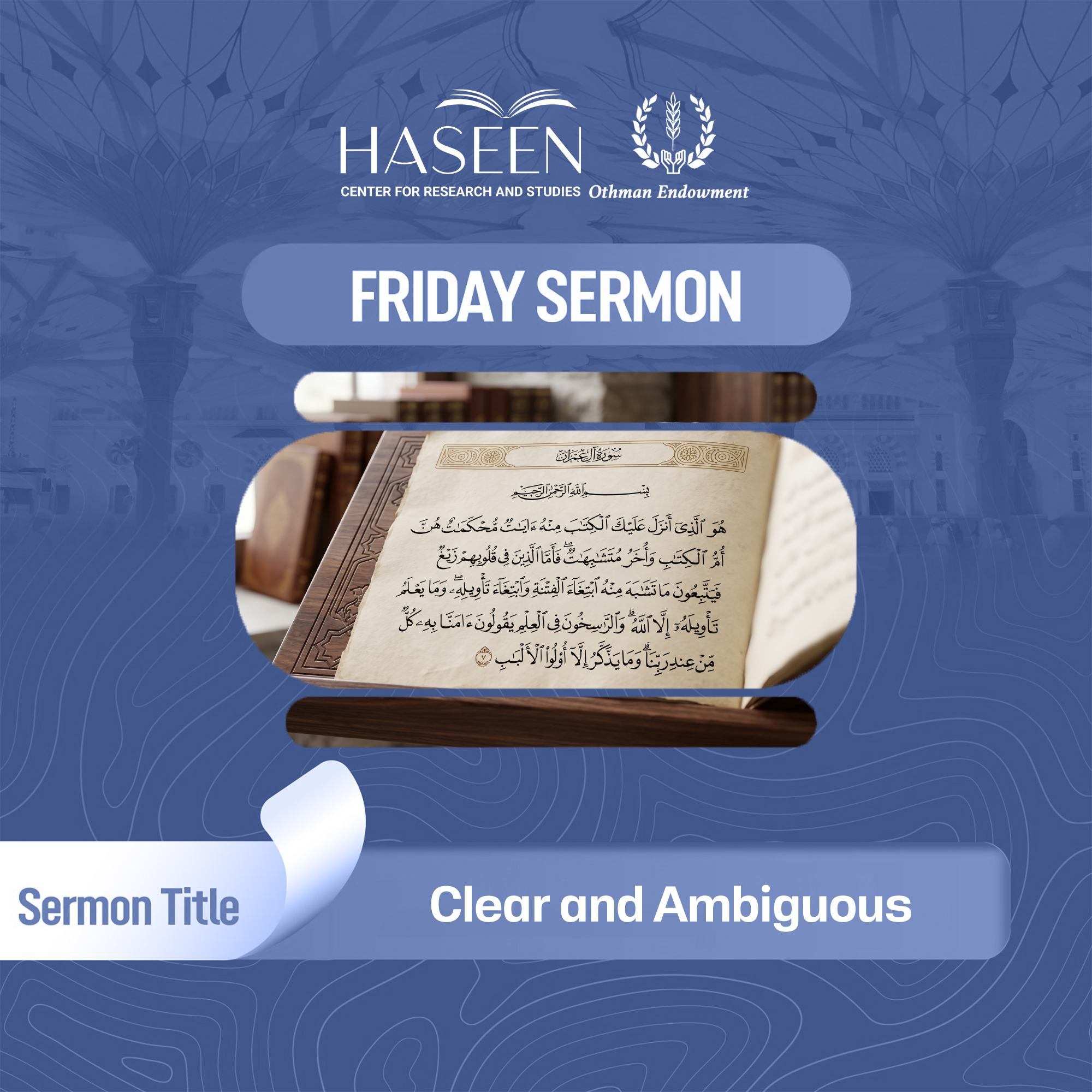
Sermon's Title: Clear and Ambiguous
Themes of the Sermon:
1- The Qur’ān Clear (Muḥkam) and Ambiguous (Mutashābih)Verses
2- The Way of the Deviated
3- The Way of the Firmly Grounded in Knowledge and the Believers
4- The Sunnah is an Explanation of the Qur’ān and a Clarification of its Complexities
All praise belongs to Allah, who perfected the verses of His Book and made it a criterion to distinguish between false speech and truth. I bear witness that there is no deity worthy of worship except Allah alone, without any partner, and I bear witness that Muḥammad is His servant and Messenger. May Allah grant him abundant peace and blessings.
To proceed: Fear Allah, O servants of Allah, with true mindfulness and piety, and remain conscious of Him in secret and in public.
يَا أَيُّهَا الَّذِينَ آمَنُوا اتَّقُوا اللَّهَ حَقَّ تُقَاتِهِ وَلَا تَمُوتُنَّ إِلَّا وَأَنْتُمْ مُسْلِمُونَ
“O you who believe, fear Allah as He should be feared and do not die except as Muslims [in submission to Him].” [Sūrat Āl ʿImrān: 102].
Servants of Allah:
Is it possible that a person could be given a illuminating lamp to guide them out of darkness, only for them to increase in darkness and misguidance through it?
Is it possible that a sick person could take the cure for their illness to be saved and healed, only for it to increase their disease and ruin?
There is no greater light, no more complete guidance, and no more beneficial cure than the Magnificent Qur’ān. For Allah the Almighty revealed it as a light, guidance, and healing for mankind, bringing them out of darkness into light. Yet, when the Qur’ān came to some people, it increased them in nothing but darkness, misguidance, and disease!
Where is the defect? And how did that happen? Allah the Almighty said, describing His Book:
قُلْ هُوَ لِلَّذِينَ آمَنُوا هُدًى وَشِفَاءٌ وَالَّذِينَ لَا يُؤْمِنُونَ فِي آذَانِهِمْ وَقْرٌ وَهُوَ عَلَيْهِمْ عَمًى
“Say, 'It is, for those who believe, a guidance and cure.' And those who do not believe - in their ears is deafness, and it is upon them blindness.” [Sūrat Fuṣṣilat: 44].
And He, Glory be to Him, said:
وَإِذَا مَا أُنْزِلَتْ سُورَةٌ فَمِنْهُمْ مَنْ يَقُولُ أَيُّكُمْ زَادَتْهُ هَذِهِ إِيمَانًا فَأَمَّا الَّذِينَ آمَنُوا فَزَادَتْهُمْ إِيمَانًا وَهُمْ يَسْتَبْشِرُونَ * وَأَمَّا الَّذِينَ فِي قُلُوبِهِمْ مَرَضٌ فَزَادَتْهُمْ رِجْسًا إِلَى رِجْسِهِمْ وَمَاتُوا وَهُمْ كَافِرُونَ
“And whenever a sūrah is revealed, there are among them those who say, 'Which of you has this increased in faith?' As for those who have believed, it has increased them in faith, while they rejoice. But as for those in whose hearts is disease, it has only added defilement to their defilement, and they died while they were disbelievers.” [Sūrat at-Tawbah: 124-125].
Indeed, the believer who truly believes that the Qur’ān is the Word of Allah—the Truth which falsehood cannot approach from before it or behind it—when the Qur’ān comes to them, they make it their leader and the path of their guidance. They submit to it and seek its judgment, increasing through their faith in it in mercy, light, and healing. As for the hypocrite who does not truly believe in Allah’s Book, the disease of their heart is following desires. When the lights of the Qur’ān reach them, they prefer blindness over guidance, and thus gain nothing from the Qur’ān except further misguidance.
But do you think the matter stopped at their own misguidance? No, indeed! Rather, they became misleaders of others as well—using the Book of Allah itself!
How is it possible for the people of misguidance to mislead people using the Book of Allah?
Allah has informed us in His Book, saying:
هُوَ الَّذِي أَنْزَلَ عَلَيْكَ الْكِتَابَ مِنْهُ آيَاتٌ مُحْكَمَاتٌ هُنَّ أُمُّ الْكِتَابِ وَأُخَرُ مُتَشَابِهَاتٌ فَأَمَّا الَّذِينَ فِي قُلُوبِهِمْ زَيْغٌ فَيَتَّبِعُونَ مَا تَشَابَهَ مِنْهُ ابْتِغَاءَ الْفِتْنَةِ وَابْتِغَاءَ تَأْوِيلِهِ وَمَا يَعْلَمُ تَأْوِيلَهُ إِلَّا اللَّهُ وَالرَّاسِخُونَ فِي الْعِلْمِ يَقُولُونَ آمَنَّا بِهِ كُلٌّ مِنْ عِنْدِ رَبِّنَا وَمَا يَذَّكَّرُ إِلَّا أُولُو الْأَلْبَابِ
“It is He who has sent down to you, [O Muḥammad], the Book; in it are verses [that are] clear (muḥkamāt) - they are the foundation of the Book - and others ambiguous (mutashābihāt). As for those in whose hearts is deviation [from truth], they will follow that of it which is ambiguous, seeking discord and seeking an interpretation [suitable to them]. And no one knows its [true] interpretation except Allah. But those firm in knowledge say, 'We believe in it. All [of it] is from our Lord.' And no one will be reminded except those of understanding.” [Sūrat Āl ʿImrān: 7].
The Prophet ﷺ recited these verses one day, then said to ʿĀʾishah (may Allah be pleased with her): “When you see those who follow what is unspecific (mutashābih) from it, then those are the ones whom Allah has named; so beware of them.” Reported by al-Bukhārī and Muslim.
What is the story of these people, and how do they follow what is unspecific from the Qur’ān to tempt people away from their religion?
Indeed, Allah sent down a Book whose verses were made precise and perfected in truth and justice. He sent it down as a book of guidance, containing clear, evident verses (āyāt bayyināt), because its purpose is to guide people to the Straight Path. However, Allah's wisdom decreed that the majority of the Qur’ān consists of verses whose meanings are completely clear without any obscurity or confusion—where only the plain, obvious meaning is understood, and no one differs over them. These are the clear verses (muḥkamāt), which are the foundation and core of the Book.
At the same time, He made some verses capable of bearing more than one meaning, where ambiguity exists. Their true meaning does not become clear except by examining and understanding them in the light of other verses—a task proficiently handled by the people of knowledge and deep study. These are the ambiguous verses (mutashābihāt).
So, what did the people of truth do regarding these verses, and what did the people of deviation do?
As for those who are firmly grounded in knowledge (ar-rāsikhūna fī al-ʿilm), due to what Allah has taught them and granted them of deep understanding of His Book and religion, the meanings of the Qur’ān’s verses are not confused for all of them together. For no era is devoid of godly scholars who stand for Allah with clear proof and clarification. They refer what is ambiguous back to the definitive verses and understand it in their light, knowing that the entire Qur’ān is from Allah, and if it had been from other than Allah, they would have found within it much contradiction. Thus, they submit and say: “We believe in it. All [of it] is from our Lord.”
As for the people of desires and misguidance, they exploit these ambiguous verses and interpret them in isolation from the definitive ones, in order to mix truth with falsehood and to attempt to dismantle the religion of Allah.
The Prophet ﷺ informed us about them, saying: “The destruction of my nation will be in the Book and in milk.” They asked, "O Messenger of Allah! What are the Book and milk?" He replied: “They learn the Qur’ān and interpret it according to other than what Allah, the Mighty and Majestic, revealed; and they love milk, so they abandon the congregational prayers and Friday prayers and live out in the desert.” Reported by Aḥmad.
You will find one of them arguing against the definitive matters (muḥkamāt) of the religion—upon which the Muslim Ummah has unanimously agreed—by using arguments from the Qur’ān. The listener might imagine that he intends good, whereas he is nothing but a misleading devil in human skin. For this reason, ʿUmar (may Allah be pleased with him) said to Ziyād ibn Ḥudayr: "Do you know what destroys Islam?" Ziyād said: "I replied, 'No.'" ʿUmar said: “It is destroyed by the slip of a scholar, the argument of a hypocrite using the Book, and the rule of misleading leaders.” Reported by ad-Dārimī.
You will hear one of them citing the statement of Allah:
إِنَّ الَّذِينَ آمَنُوا وَالَّذِينَ هَادُوا وَالنَّصَارَى وَالصَّابِئِينَ مَنْ آمَنَ بِاللَّهِ وَالْيَوْمِ الْآخِرِ وَعَمِلَ صَالِحًا فَلَهُمْ أَجْرُهُمْ عِنْدَ رَبِّهِمْ وَلَا خَوْفٌ عَلَيْهِمْ وَلَا هُمْ يَحْزَنُونَ
“Indeed, those who believed and those who were Jews or Christians or Sabeans [before Prophet Muḥammad] - those [among them] who believed in Allah and the Last Day and did righteousness - will have their reward with their Lord, and no fear will there be concerning them, nor will they grieve.” [Sūrat al-Baqarah: 62].
arguing that all people will enter Paradise—Jews, Christians, and Sabeans—so long as they acknowledge the existence of Allah. They abandon the definitive, decisive verses that strictly mandate the Monotheism of Allah (Tawḥīd), submission to Him in Islam, and belief in Him, His books, His messengers, the Last Day, and the Divine Decree (Qadar), as He, the Almighty, said:
وَمَنْ يَكْفُرْ بِاللَّهِ وَمَلَائِكَتِهِ وَكُتُبِهِ وَرُسُلِهِ وَالْيَوْمِ الْآخِرِ فَقَدْ ضَلَّ ضَلَالًا بَعِيدًا
“And whoever disbelieves in Allah, His angels, His books, His messengers, and the Last Day has certainly gone far astray.” [Sūrat an-Nisāʾ: 136].
And as He, the Almighty, said:
وَمَنْ يَبْتَغِ غَيْرَ الْإِسْلَامِ دِينًا فَلَنْ يُقْبَلَ مِنْهُ وَهُوَ فِي الْآخِرَةِ مِنَ الْخَاسِرِينَ
“And whoever desires other than Islam as religion - never will it be accepted from him, and he, in the Hereafter, will be among the losers.” [Sūrat Āl ʿImrān: 85].
Furthermore, the meaning of the verse is not as these distorting manipulators claim. Rather, its true meaning is that whoever believed in Allah, the Last Day, and all other pillars of faith—including the Messengers—and performed righteous deeds during their respective times, their faith is accepted by Allah. Indeed, whoever disbelieves in a single Messenger has disbelieved in Allah who sent him, and is not a believer in Allah in the first place.
And you will hear one of them trying to justify polytheism (shirk) with Allah—by seeking aid from the dead and exaggerating the status of the righteous—saying: "Did Allah the Almighty not say regarding the Companions of the Cave:
قَالَ الَّذِينَ غَلَبُوا عَلَى أَمْرِهِمْ لَنَتَّخِذَنَّ عَلَيْهِمْ مَسْجِدًا
'Those who prevailed over their affair said, "We will surely build over them a place of worship."' [Sūrat al-Kahf: 21]?!"
They leave behind the definitive verses that uprooted the disease of shirk from the hearts. Yet, the verse offers no proof for their falsehood; rather, the utmost it shows is that those who possessed power and authority were the ones who did that, not the people of Islam and guidance.
Besides, did our Prophet ﷺ not inform us that Allah cursed those who did such things, saying: “May Allah curse the Jews and the Christians; they took the graves of their Prophets as places of worship”? Reported by al-Bukhārī and Muslim.
How numerous are their misguidances! Nevertheless, if a Muslim reads something from the Book of Allah and it seems ambiguous to them, or if they imagine a contradiction with another verse or ruling, or if they hear from one of the mouthpieces of misguidance something that contradicts the definitive principles of the Qur’ān, they must first believe in the entire Qur’ān. Then, they must refer the ambiguous back to the definitive, which contains no confusion and serves as a guiding lighthouse on the road. After that, they should consult the scholars who are firmly grounded in knowledge, so they may explain the nature of the ambiguity and distinguish truth from falsehood.
This methodology was taught to us by the Messenger of Allah ﷺ. When he heard some people one day pitting verses of the Qur’ān against one another, he said: “Indeed, those who came before you were destroyed by this: they pitted parts of Allah's Book against other parts. But the Book of Allah was revealed with its parts confirming one another. So do not pit parts of it against other parts. Whatever you know of it, speak of it; and whatever you do not know, entrust its knowledge to the one who knows it.” Reported by Aḥmad.
This methodology became firmly established among the Companions of the Prophet ﷺ, and they advised those who came after them to adhere to it.
Muʿādh ibn Jabal (may Allah be pleased with him) said: “The Qur’ān is the truth, and upon it is a guiding light like a lighthouse on a road, hidden from no one. Whatever you recognize, accept it; and whatever you find unfamiliar, entrust its knowledge to the one who knows it.” Reported by Abū Dāwūd in az-Zuhd.
And when a man asked Ibn ʿAbbās (may Allah be pleased with them both) about some ambiguous verses in the Book of Allah, he explained their definitive meanings to him, and then advised him, saying: “Know that whatever seems conflicting to you in the Qur’ān is similar to what I have explained to you. Indeed, Allah the Almighty revealed nothing except that He intended a precise meaning by it, but people do not know. So do not let the Qur’ān seem contradictory to you, for all of it is from Allah, the Blessed and Exalted.” Reported by al-Bayhaqī.
May Allah bless me and you through the Great Qur'an, and benefit me and you through the verses and wise reminders it contains. I seek Allah's forgiveness for myself and for you, so seek His forgiveness; indeed, He is the All-Forgiving, the Most Merciful.
The Second Sermon:
All praise belongs to Allah, and may peace and blessings be upon the Messenger of Allah, his family, his companions, and those who follow him. To proceed:
Indeed, Allah has left no excuse for anyone against Him. Whoever is guided, it is by His favor; and whoever strays, Allah causes their heart to deviate. Allah has set down for us the rules of guidance, and among them is His statement, Glory be to Him:
وَأَنْزَلْنَا إِلَيْكَ الذِّكْرَ لِتُبَيِّنَ لِلنَّاسِ مَا نُزِّلَ إِلَيْهِمْ وَلَعَلَّهُمْ يَتَفَكَّرُونَ
“And We revealed to you the message [O Muḥammad] that you may make clear to the people what was sent down to them and that they might give thought.” [Sūrat an-Naḥl: 44].
If there are general verses in the Qur’ān that carry multiple possible meanings, their interpretation and the clarification of their complexities are found in the Prophetic Sunnah. For this reason, it was reported that ʿUmar ibn al-Khaṭṭāb (may Allah be pleased with him) said: “There will come people who will argue with you using the ambiguous matters of the Qur’ān, so confront them with the Sunnahs, for the people of the Sunnah are the most knowledgeable regarding the Book of Allah.” Reported by al-Ājurrī.
There is no person of falsehood who uses a general verse as a path to tempt people into trial except that the clarification of that general verse, and the explanation of its complexity, is found elsewhere in the definitive verses of the Qur’ān and the authentic Prophetic Sunnah.
That is why these heretics (zanādiqah) were eager to tear down the Sunnah and slander it, so that arguing with the ambiguous verses of the Qur’ān would become easy for them. But how could they achieve that when Allah has planted in this Ummah, in every era, godly scholars who negate the distortions of the people of falsehood from His religion?!
O Allah, aid us and do not aid others against us; grant us victory and do not grant victory over us; plan for us and do not plan against us; and grant us victory over those who transgress against us.
O Allah, grant us safety in our homelands, rectify our leaders and those in authority over us, and place our leadership under the care of those who fear You, remain mindful of You, and seek Your pleasure.
O Allah, be with our oppressed brothers and sisters in Gaza and everywhere, and decree for them a near victory and relief.
Servants of Allah: Remember Allah with much remembrance, and glorify Him morning and afternoon. And our final call is: All praise belongs to Allah, Lord of the Worlds.